Affichage des articles dont le libellé est Classical antiquity. Afficher tous les articles

lundi 17 juillet 2017

[List II/22d] Kingdom of Characene

Army list. My army consists of two Arabo-Aramaic bodies of the Osmani tribe, who ruled the kingdom (list II/22d) and a body of nomadic pre-Islmaic Arabs (List II/23a). I chose to represent the Roman and Parthian period of the kingdom. The generals and heavy infantrymen are of the pure Arabo-Aramaic style as they were found in Hatra or Palmyra. The archers on foot are represented, as well as the light infantry, by veteran troops such as the pre-Islamic Arabs. The camel riders ride on naked dromedaries, less harnessed than the cataphractary dromedaries that could be found in Hatra or in certain armies of the Parthian suzerain.

- 2 Generals 4Kn
- 2 Light cavalry LH
- 2 Light camelmen LCm 
- 2 Heavy infantry 4Bd
- 3 Heavy javelinmen 3Ax
- 13 Archers Ps
Nomadic allies
- 1 General Cv
- 1 Light cavalry LH
- 1 Light camelmen LCm 
- 4 Camelmen Cm
- 3 Heavy infantry 4Bd
- 2 Archers Ps                         

 The Characene (or Kharacene or Caracene or Charakene or Mesen or Meshun in Judeo-Aramaic: חבל ימא, Hevel Yama "the land of the sea") is a former independent (or semi-independent) Hellenistic kingdom, located in the extreme South of the fertile region which lies at the mouth of the Tigris and the Euphrates, on the Arabian-Persian Gulf. In fact we do not really know its borders. They are different according to classical authors or geographers, but are traditionally associated with the southern region of Babylonia, in present-day Iraq, Iran and Kuwait.

    Basically, the kingdom must have as its boundaries to the west, the Arabian desert, to the north, the Chaldean marshes and to the south the Persian Gulf. Several islands in the Persian Gulf, including Bahrain, also belonged to the kingdom of Characena. It was created at the end of the 2nd century BC and was a vassal of the Parthian empire. It is very probable that the official language of the kingdom was the Greek koinè, the language spoken in the Hellenistic or Hellenized countries, but there is no certainty even today on this subject.

Source: Antikforever.com


 The kingdom of Characene is founded about 127 BC. BC by Aspasinè, named Hyspaosines by classical authors, an ancient satrap of Antiochos IV Epiphanes. Surviving the dissolution of the Seleucid Empire, the Characene became a vassal of the Parthian Empire until its fall at the beginning of the third century. The Sassanid kings put an end to the local royal dynasty and replaced it with governors.

Although vassal of the Parthians, the kingdom has always had a pro-Roman policy, and welcomed the Roman invasion of Trajan in 116. The emperor himself stays at Spasinou Charax, and personally attends the departure of the ships for India, regretting being too old to undertake the journey, as Alexander of Macedonia had done. Thereafter, the kingdom seems to have escaped long enough for the Parthians to take over Mesopotamia, it is only in 150 that it returns to the zone of direct influence of the empire of the Arsacides after the defeat of the King Meredate (or Meherdate) before Vologese IV. The latter undoubtedly takes an important spoil from Spasinou Charax, including a statuette of Hercules found in Seleucia of the Tiger and bearing the inscription that revealed this episode.

Source: Wikipedia


Coins of king Meredathes


Meredates seems to have been placed on the throne of Characene may be as governor initially, by a successor of his father Pacorus II after the Romans were driven out of the area of ​​Parthians. However, their invasion was at the origin of a civil war in the Parthian empire and Vologese IV was the son of a major rival of Pacorus II for the throne of "Great King." Vologesius IV attempted to re-establish his authority over several provinces of the Parthian empire which had declared independence during the war against Rome.

Meredates is also known by some coins, and by an inscription discovered in Palmyra. He was a son of Pacorus II as indicated by his coins stamped in the most Parthian style arsacide. The mention on the pieces confirms his filiation "Meredates, son of Phokoros, King of Kings, King of Omani"

jeudi 15 juin 2017

Egyptian sphinx

It is a small sphinx that can be used with my Egyptians, the Ptolemaïcs of Antoine or any other army of this region. 

It is intended to be played as a building, or even to be just used in decor without affect on the game, posed just for the visual and moved if it hinders the figurines. I did not want a sphinx too big but it nevertheless has a size giving it a look on the table.


mardi 7 février 2017

[List II/46] Kuchan luggages

The luggage of my Kushan army is represented by a packing elephant. Two Scythian riders composing his crew gave the luggage the "Yuezhi" chrome characteristic of the Kouchanes riders.

The nomadic influence of the army is represented by the great number of quiver and gorytes carried.


Gandhara, Graeco-Buddhist art (1st to 5th century AD) Part of frieze in gray schist representing an elephant carrying a load on the back. Greco-Buddhist art is a synthesis of Greek and Indo-Buddhist styles that started in Gandhara (an ancient kingdom of Afghanistan and northwestern Pakistan centered on the Swat and Kabul valleys, two tributaries of The Indus) when the Indo-Greek rulers, descendants of the companions of Alexander the Great, came into contact with Indian Buddhists, especially under Menander I (reign 160-135 BC), called Milinda Sanskrit.

    The relay of the Indo-Greeks was taken in the first century by the Kushan rulers whose zenith is under Kanishka I, another great protector of Buddhism.

    One of the notable aspects of Greco-Buddhist statuary is the figurative representation of the Buddha, formerly represented in symbolic form (wheel, footprint), which took the face of the Greek gods and especially of Apollo. The style of Gandhara flourished from the 1st century, under the Kushan dynasty, in the 5th century, when it disappeared with the invasion of the Shvetahūna, or white Huns. The Buddhas of Bamiyan, destroyed in 2001 by the Taliban, were one of the most spectacular achievements of the Greco-Buddhist art of Gandhara.

Text above and photo below taken from the site of sale Proantic.com
"Shale elephant - Gandhara region (1st-5th c.) - Archeology"
 

samedi 7 janvier 2017

[List II/9a] Syracusans 212 BC


Syracuse was a city of Greater Greece, located on the east coast of Sicily. The city was founded in 734 BC by Greek settlers from Corinth.

In its history, as an independent city, it was governed by tyrants, interspersed with short democratic and oligarchic periods. In 304 BC, the tyrant Agathocles took the title of king (basileus), title taken up by his successors.

Syracuse remained independent until 212 BC, when it was conquered by the Romans during the Second Punic War. It later became the seat of Roman domination in Sicily.

My army, constituted in BBDBA format, represents the Syracusan army in 212.


The figurines used are those photographed in the page devoted to the classical Greeks. On the other hand, some particularities concern the typically Syracusan platelets.

Some Carthaginian figurines are integrated on platelets to represent the use of Punic material (coats of mail, helmets ...) by some Syracusan hoplites.


Some shields bear motifs copied from Syracusan coins.


The army also employs a few mercenaries: two Iberian plates and a plate of Ligures. It is also possible for him to align Gauls (4Wb), which I do sometimes using my Gaulois bases (alas basement in 3Wb)

Iberian mercenaries
Ligurian mercenaries

Archimedean mirrors

    In 215 BC, Archimedes organized the defense of Syracuse in the face of the invasion of the Romans and of General Marcellus during the Second Punic War, during which the inhabitants of Syracuse had allied themselves with the Carthaginians after being the allies of Rome for nearly half a century. 
For three years he built war machines to resist the Roman galleys facing Syracuse. 
 Anthemius of Tralles (474-534) tells the story of the use of catapults and fiery mirrors in this battle become legendary
.Référence: Le cabinet de physique de Sigaud de Lafond


The use of mirrors as a weapon in themselves is impossible according to archaeologists. Experimental archeo attempts are best at 160 ° C, well below the 350 ° required to ignite a trireme.

The pointer hypothesis relies on the need to group several projectiles on the same target. The target ship is designated by the mirror. A priori, several bronze plates (an article even speaks of hexagonal shapes but I do not know why) Several ballista with flaming features then unite their shots against the same ship.

On the other hand, it goes without saying that this mirror is in no way fixed on a ballista itself.

I think of the general shape of the mirror of Lavoisier by adding pivots to the mirror itself (for the general form, I know well that for Lavoisier, it is quite different since the sun is directed towards the rear of the craft ). But that will be for later, when I will tamper with my current balistes. At least one of the balists will not be transformed in order to be able to be aligned, without a mirror, in other Greek armies than that of Syracuse (Phocaeans)


The version chosen by Greg Kelleher for his 15mm Syracusan army. He seems to have opted for the weapon mirror. Even if it's impossible, it gives a funny thing:


The archimedes balistes as I presently represent them (two of them will later be endowed with a mirror.


These ballista are Hät 1/72 plastic (with servants 28mm foundry) The rendering is nice and the low cost (about 5 € for 4 pieces of artillery)


[List II/5] Greek cities in "12 elements DBA"

The large number of Greek figurines I have allows me to align different cities, which allows us to set up a campaign on the theme of the ancient Greek wars.


List II / 5a Spartans
It is an army designed specifically in DBA by my son Antoine. She has her own page on this blog: "Étranger, va dire à Sparte qu’ici Nous gisons, dociles à ses ordres."


List II / 5b Athenians
The city that I find most interesting historically. One of his interests is the possibility of changing a psilos to archers (3Bw) What I can do for now, not having 3Bw Greek.


List II / 5c Thebans
It is an army destined to be played in big battle. I still lack six figurines of riders to be able to align them as such. When the army is over; She will have her own page on this blog. Meanwhile, it is played with a Thesalian ally, which reduces the number of riders needed.
An arrangement is however necessary because the Thessalian general (Cv) is represented by an LH (always this lack of riders) easily identifiable by its blue crest and played as Cv during the friendly parties.


List II / 5d Théssaliens
The Thessalians have the particularity, for Greeks, to have many light riders.


List II / 5th Etolians
A plethora of light infantrymen (Ps) This reduces the striking force but gives the army a great flexibility which has every interest to take advantage of the cutlery and can, in any case tickle the enemy lines in a particularly painful way for the latter.


List II / 5f Phocaeans
This army possesses the rare peculiarity of an artillery for a Greek army of that period. A quarter of the troops are also light infantry.


List II / 5g Italotes
Greek colonies in the Italian peninsula. This army offers a structure comparable to that of the Thessalians, lining up an important light cavalry. It is a pity to be able to line up with Oscar allies because this would have made it possible to constitute a pretty and colorful BBDBA army.


List II / 5h Sicilians
It is noted that this army does not represent that of Syracuse which has a clean list in the rules and on this blog.


List II / 5i Other Greek armies in Greece
Here we have the "classic" version of the hoplitic armies. A hoplite wall, a cavalry in reserve (or an extra hoplite) and a little psiloi for difficult terrain.


List II / 5j Expeditions of Outremer
Such, for example, that of Xenophon. Little variety of troops. 100% lancers. A line. A wall. Simple and often efficient, although its heavy and monolithic aspect sometimes makes this army vulnerable.


List II / 5k Spartan expedition to Asia (Brasidias)
A light version of the Spartan army. The opportunity to play these terrible beards while enjoying more tactical flexibility.


List II / 5L Greek Black Sea Cities
This army enjoys the support of its Scythian neighbors.


List II / 9a Syracuse
This army is at the origin of my purchase of Greek figurines. It was built in BBDBA version and has, in the rules and in this blog, its own page.

jeudi 5 janvier 2017

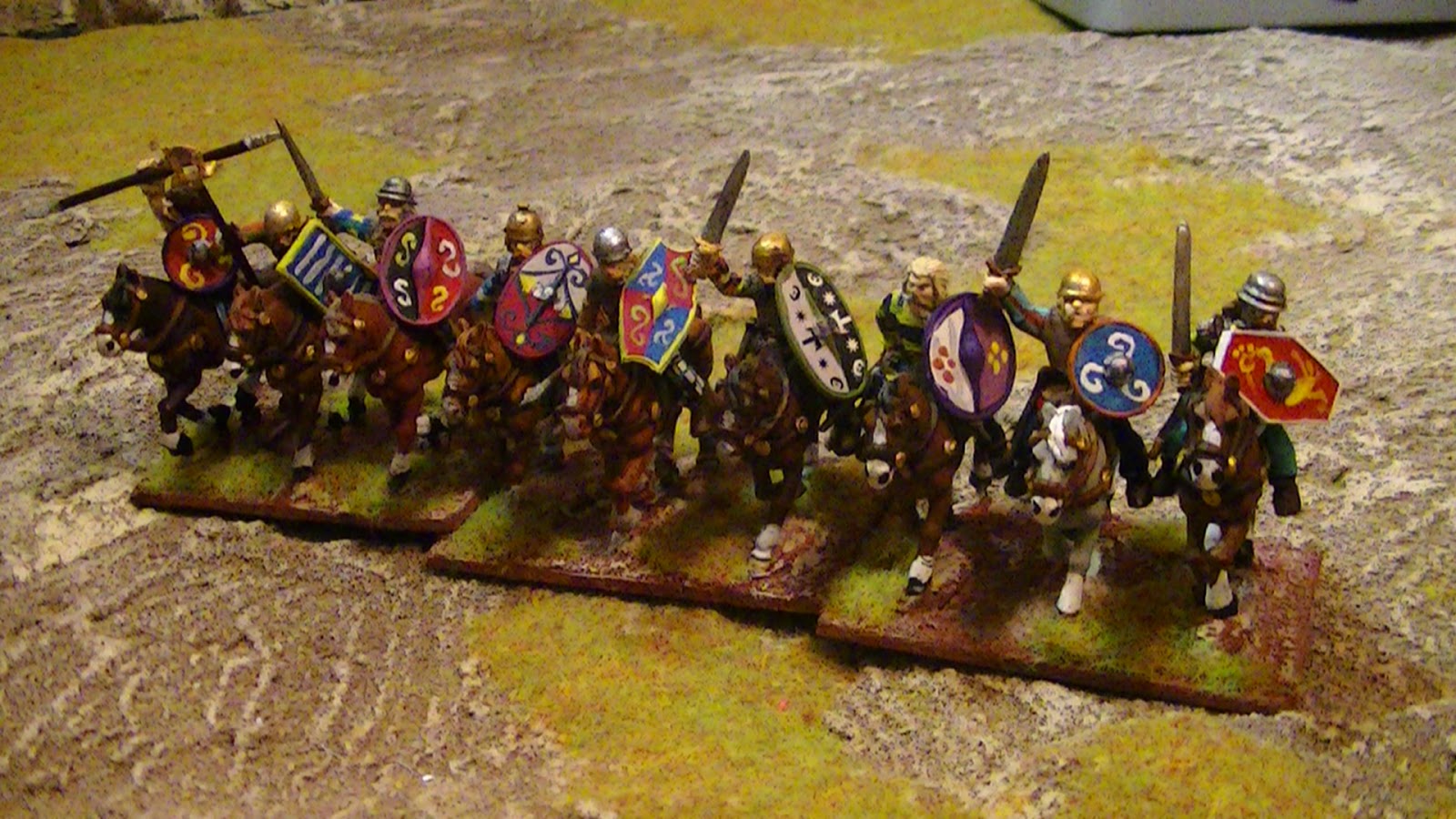
[List II/11] Vercingetorix's Gauls


This is my late Gallic army. Emphasis is placed on the period of the Gallic war (large cavalry, absence of tanks and, above all, figurines chosen according to their equipment.) The helmets too old or "typical Breton" were rejected for privileged helmets typical of the war Of Gaul)

Link to an article that I realized on a forum of history game concerning the helmets Gallic Here.


 The army has only three types of troops: 15 riders, 18 warriors and 3 tirailleurs with bow.

 It contains several figurines converted to give them historical helmets (manufacturers of figs tending to mix epochs or geographical areas in their Celtic blisters) Concerning Vercingetorix I chose to privilege a figurine recalling its appearance on the coins (Even if these representations were in fact only symbolic): a beardless warrior with long hair and bare head.

Gallic high command
Vercingetorix
Critognatos
Vercasivellaunos


Example of conversion made to equip the miniatures with ad hoc helmets


Baggages: