Affichage des articles dont le libellé est Battles. Afficher tous les articles

dimanche 26 février 2017

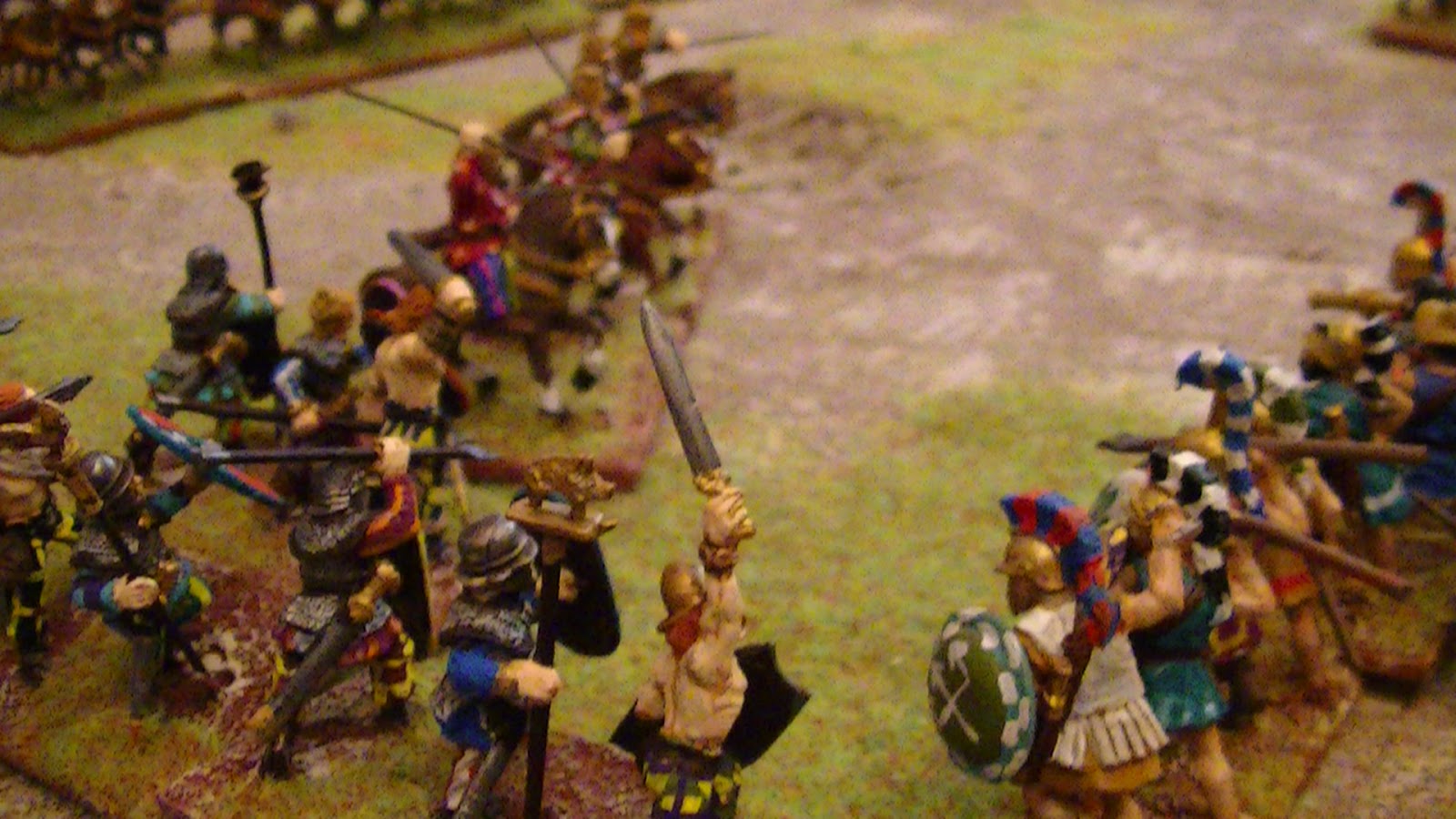
Medieval game on a medieval camp, spring 2012

It is not strictly speaking a battle report.

Just a few pictures that I found in my computer.
They are from spring 2012.

DBA parties on the evening of a training day at the Mesnie Enguerran (re-enactment 1380-1420)
The rule played then was v2.2


mercredi 28 décembre 2016

Assur-etil-ilâni and Sîn-shar-ishkun by the sea


Historical battle between the Assyrians of Kevin and the Neo-Babylonians of Jerome. The action seems to have taken place near the modern city of Fao, where the Shatt-el-Arab flows into the Persian Gulf.

The terrain includes a waterway (the Chatt-el-arab or the shores of the Persian Gulf), two woods and a small city (BUA). The road visible on a photo serves just to delimit the playing surface.

The action takes place in the seventh century before our era Assurbanipal died around 627, and his son Assur-etil-ilani succeeded him on the throne of Assyria. Sîn-shar-ishkun is apparently designated to be king of Babylon, while remaining in the lower position. Sîn-shar-ishkun quickly enters into rivalry with his brother, while another character seeks to dominate Babylonia: the Chaldean Nabopolassar. A war breaks out in Babylonia, which is joined by the eunuch Sin-shum-lishir, who supported Assur-e-ilani at the beginning.

The contingent sent by Assur-etil-ilani

The interception force of Sin-shar-ishkun is based on the city of Fao
The Assyrian tanks. The tent represents the Assyrian camp.


The Assyrian riders. We still wonder (and he too!) Why Kévin put them in 6x6cm.
The Assyrian infantry: four units of Kisir Sharutti and two levies.
The Neo-Babylonian infantry relies on the Chaldean archers guarding the Greek mercenaries.
The Babylonian sharpshooters opened hostilities by rushing forward to the cover of the wood on their right wing.
View from the Babylonian lines.
The shin-shar-ishkun maneuver is very readable. The general sent by Assur-etil-ilani reacts by redirecting a unit of auxiliaries, a tank and the cavalry to its right wing.
The Babylonian sharpshooters came out of the woods to take the Assyrian infantry from the flank.
Assyrian troops sent as reinforcements on the right wing are unfortunate.
The same situation seen from the Assyrian side.
The sidewall fails and the Babylonian skirmishers are pushed back at first; Repeated assaults will however bear fruit and the Assyrian flank will collapse two turns later.

Fights on the assyrian flank
Fighting drags on.
The Assyrian cavalry took over from Babylon and destroyed one. A tank will be sent to fill the gap.


The god Assur will hit a big shot by suddenly unloading the battery of my camera. This view is the last of a battle that will culminate in a 4/1 victory of the Neo Babylonians.
Sîn-shar-ishkun congratulates his troops on the evening of the battle.


jeudi 22 décembre 2016

[DBA] Assyrians vs Midianites looters


This part opposed the Assyrians of Kevin to my Midianite Arabs. It is therefore a part with historical context, the troops of Assurbanipal seeking to dislodge the Bedouin plunderers out of their territory in order to secure the Assyrian lands.

The wise eyes notice that the right of the ground is "photoshopée". Indeed, as two games were held at the same time, our game space "bite" on the waterway of my table (I have not yet realized its cache). We treated it as ordinary ground. That would have a little shocked on the pictures. The midianite camp (not visible in the photo) is placed on the left wing behind the camel drivers.

The terrain consisted of two dunes, a palm grove / oasis and two rocky / rocky terrain.


The Assyrian is the attacker. Aside from a palm grove, the land contains only elements favorable to dromedaries (dunes, rockeries ...)

The Assyrian army seen from the Midianites

The Assyrian army (the figurines in the background are those of another part unfolding at the same time.)
The psiloi midianites, taking advantage of the cover of the palm grove, threaten the Assyrian hordes and, on the other side, watch the main advance of Assurbanipal.

Supported by the psiloi, a unit of camels managed to envelop the Hordes, attacked on all sides. It will be the first two losses of the Assyrian army but their status as a sacrificial troop allowed their companions to ignore their disappearance superbly.

The nearby camp, however, will now be offered to the appetites of midianite looters and will be the first real loss. Similarly, the hole made on the Assyrian left wing quickly brought about the disappearance of two infantrymen, caught in flank by the Midianite right wing exploiting its breakthrough. The surprise will rely mainly on the speed with which this carnage will unfold (DBA remains a game subject to the god D6)

A column of midianite warriors enters the palm grove. Following him (but outside the palm grove), the general positions himself in order to have a chain of command towards all his troops.
The meharists of the left island take refuge in the cutlery so as not to be caught between the Assyrian horsemen and infantry. They adopt a funny training to avoid the unpleasant surprise that would have been the burden of the riders in the cutlery (taking flank, impossible retreat, all that sort of things...)

The Assyrian cavalrymen, too confident, bypass the canopy. The meharists then arise in a storm and easily destroy a unit of horsemen caught flank and unable to retreat.

Taken from the flank at the edge of the palm grove, Midianite warriors resist this ultimate Assyrian charge. This battle will remain there, the Assyrian army demoralized, leaving the battlefield.
On the evening of the battle, the Midianites give rest to their dromedaries. (Even if the Assyrian bas-reliefs show, originally, an Arab captivity and take of war).

vendredi 11 novembre 2016

Noyon championship 2016-2017

This is actually ranking our various armies big battle based on their results on the battlefield. The ranking is established by army, irrespective of the player who plays them.

The primary goal is to diversify our oppositions (otherwise we are always encouraged to play our favorite armies and the parties are less varied) but it will also allow us to establish an inventory of the effectiveness of our armies to the test Of fire, which can only be achieved over a long period of time in the face of a multitude of varied oppositions.

This championship began in October 2016 and will be completed in 2017 when each of the engaged armies has met each other.


J: Played games (20 games to play per army in total)

V: Number of victories
D: Number of defeats
N: Number of drawes (Less than 10 points of deviation or simultaneous demoralizations of armies)

Points:
In the event of a tie at the points, the army having fought the fewest battles is ranked in front.

Explanation of the points:

The winner of a game scores 72 points minus the number of lost items.
The defeated marks the number of enemy platelets killed or demoralized.
In case of draw, the two armies mark their points as defeated.

As the games are not limited in time, zero matches can only occur if the two enemy armies are demoralized in the same turn.

This type of calculation encourages the search for victory, more profitable, than a simple "game against the clock".

2-point bonus per general killed enemy (Winner as defeated scoring these points if applicable)
2 points bonus per demoralized enemy corps (Only the defeated marker if applicable)
Bonus of 4 points if taken from the eventual built-up area enemy. (The attacker scores these points if the city is taken and not retrieved by the defender)
Bonus of 4 points if taken from the enemy's camp. (Winner as defeated scoring these points if applicable)

Provisional classification (dated 07.06. 2017)

21 Armed forces  

 1-  Mitanni P12 V9 D3 DRAW0  613 points
 2- Kuschans P13 V7 D5 DRAW1  565 points
3- Vercingetorix Gauls P12 V7 D5 DRAW0  563 points
4- Bronzeage Europeans P12 V7 D4 DRAW1  562 points (Ex-aequo)
 Hittites P14 V7 D6 DRAW1  562 points (Ex-aequo)
6-   Middle imperial Romans P13 V7 D6 DRAW0  548 points 
 7- Classical ancient Greeks P13 V6 D7 DRAW0  534 points
  8- Medieval English P13 V7 D6 DRAW0  524 points
9- Neo Babylonians P12 V7 D5 DRAW0  491 points
10- Antonius & Cleopatra (Ptolemaic) P11 V6 D5 DRAW0  467 points
11- Dunhuang P12 V6 D6 DRAW0  454 points
12- Tamil Indians (Kingdom of Chola) P11 V6 D5 DRAW0  452 points
13- Seleucids P12 V6 D6 DRAW0  447 points
14-  Samouraï P12 V6 D6 DRAW0  443 points
 15- Han Chinese  P12 V5 D7 DRAW0  405 points 
16-  Aztecs P12 V5 D6 DRAW1  386 points  
17-  Minoans P12 V4 D7 DRAW0  367 points
18- Siameses P12 V4 D8 DRAW0  354 points 
19- Ancient british Celts P13 V5 D8 DRAW0  347 points 
20- Medieval French P13 V4 D9 DRAW0  340 points 
 21- Hussites P12 V4 D8 DRAW0  313 points


125 Confrontations (dated 07.06. 2017)

Kuschans vs Hittites (74 à 00) / Chinese Han vs Medieval French (63 à 17) / Neo-babylonians vs  Indians (55 à 21) / Romans vs Hittites (20 à 70) / Ptolemaic vs Mitanni (14 à 62) / Seleucids vs Greeks (03 à 71) / Kuschans vs Aztecs (38 à 40) / Neo-babylonians vs Dunhuang (02 à 74) / Ptolemaic vs Europeans (03 à 71) / English  vs Minoans (66 à 14) / Siamese vs British (72 à 02) / Gauls vs Minoans (19 à 56) / French vs Samouraï (06 à 66) / Seleucids vs Mitanni (10 à 70) / Romans vs Neo-Babylonians (67 à 11) / French vs English (02 à 72) / Han vs Dunhuang (03 à 69) / Seleucids vs Hittites (58 à 16) / Aztecs vs Europeans (02 à 70) / Siamese vs Indians (13 à 63) / Greeks vs British (71 à 03) / Hussites vs Samouraï (70 à 10) / Gauls vs Hussites (19 à 57) / Aztecs vs British (18 à 56) / Ptolemaic vs Indians (72 à 02) / Han vs Europeans (72 à 06) / Romans vs Siameses (66 à 14) / Gauls vs Greeks (77 à 00) / Kuschans vs Dunhuang (09 à 73) / Hussites vs Minoeans (15 à 59) / Samouraï vs English (67 à 05) / Romans  vs French (59 à 17) / Hussites vs Mitanni (63 à 11) / Kuschans vs Gauls (08 à 68) / Aztecs vs Hittites (08 à 74) / Ptolemaic vs Greeks (73 à 03) / English vs Indians (07 à 69) / Dunhuang vs Europeans (03 à 69)  / Seleucids vs British (72 à 06) / Hussites vs Siameses (09 à 65) / Seleucids vs French (67 à 09) / Samouraï vs Han (04 à 68) / Romans vs Minoeans (67 à 09)  / Greeks vs Indians (13 à 65) / Mitanni vs Hittites (73 à 04) / Kuschans vs British (71 à 01) / Han vs Aztecs (14 à 62)  / English vs Siameses (62 à 12) / Gauls vs Dunhuang (10 à 62) / Neo-babylonians vs Mitanni (67 à 05) / Neo-babylonians vs Europeans (05 à 69) / Samouraï vs Ptolemaic (05 à 69) / Europeans vs Minoeans (57 à 19) / Kuschans vs Minoeans (63 à 09) / Hittites vs British (11 à 67) / Hussites vs French (07 à 67) / Gauls vs Aztecs (19 à 67) / Han vs Mitanni (16 à 58) / Greeks vs Siameses (61 à 15) / Romans vs Samouraï (71 à 05) / Neo-babylonians vs English (04 à 69) / Dunhuang vs Indians (02 à 70) / Seleucids vs Ptolemaic (72 à 05) / English vs Hittites (08 à 66) / British vs Samouraï (03 à 69) / Gauls vs Han (70 à 02)  / English  vs Dunhuang (63 à 12) / Kuschans vs Siameses (19 à 56) / Europeans vs French (63 à 17) / Seleucids vs Minoeans (06 à 68) / Greeks vs Hussites (06 à 68) / Aztecs vs Ptolemaic (59 à 15) / Samouraï vs Siameses (70 à 06) / Mitanni vs Romans (71 à 09) / Neo-babylonians vs Minoeans (72 à 02) / Gauls vs British Celts (02 à 76)  / Aztecs vs Frenchs (01 à 71) / Chola vs Hittites (08 à 68) / Chola vs Europeans (03 à 71) / Neo-babylonians vs Minoeans (72 à 02)  / Greeks vs Mitanni (16 à 68) / Dunhuang vs British Celts (16 à 56) / Kuschans vs Samouraï (69 à 09) / Kuschans vs E,glishs (47 à 11) / Gauls vs Seleucids (02 à 76)  / Aztecs vs Greeks (10 à 68) / Minoeans vs ¨Ptolemaïcs (02 à 78) / Seleucids vs Europeans (71 à 07) / Aztecs vs Romans (63 à 13) / Hussites vs Ptolemaïcs (03 à 71) / Gauls vs Han (71 à 03) / Dunhuang vs French (06 à 70) / Kuschans vs Chola  (57 à 19) / Chola vs Romans (60 à 14) / Englishs  vs Mitanni (18 à 56) / Dunhuang vs Siameses (71 à 05) / British Celts vs Hussites (70 à 04)  / Hittites contre Han (65 à 09)  / Kuschans vs Greeks (13 à 65) / Neo-babylonians vs Frenchs (68 à 06) / Gauls vs Europeans (70 à 10) / English vs Seleucids (70 à 08) / Han vs British Celts (71 à 03)  / Minoeans vs Mitanéens (09 à 65) / Ptolemaïc vs Hittites (64 à 14) / Europeans vs Hussites (54 à 21)  / Dunhuang vs Romans  (66 à 10) / Gauls vs Frenchs (73 à 01) / Aztecs vs Siameses (59 à 15) / Kuschans vs Mitanni (74 à 02) / Minoéens vs Hittites (70 à 12) / Chola contre Seleucids (72 à 00) / Han vs Englishs (04 à 68) / Dunhuang contre Grecs antiques (00 à 74)  / British Celts vs Mitanni (02 à 70) / Neo-babylonians vs Samouraï (05 à 67)  / Seleucids vs Hussites (71 à 03) / Siameses vs Frenchs (72 à 02) / Aztèques vs  Minoéens (00 à 72) / Hittites vs Greeks (76 à 02) / Bretons antiques vs Europeans (02 à 72) /  Han vs Lagides (72 à 03)  / Néo-babyloniens vs Siamois (71 à 09) / Romans vs Hittites (66 à 06) / Samouraï vs Greeks (68 à 08) / Kuschans vs Romans (03 à 71) / Hussites vs Hittites (03 à 69)

Hall of fame (en date du 07.06. 2017)

Trophy Poliorcètos (Provisional) : Minoéens et Romains Moyen empire (Ex-aequo)
Villes prises: 3 (Ville anglaise médiévale par Minoéens / Ville Indiens Chola par Romains Moyen empire)

Trophy Attila (Provisional) : Romains Moyen empire (3 Camps pris)
Camps pillés: 10 (Camps néo-Babylonien par Romains Moyen empire / Camps Samouraï par Hussites / Camps européen âge du bronze par Chinois Han / Camps Siamois par Romains Moyen empire / Camps grec par Gaulois / Camps Kouchane par Dunhuang / Camps Aztèque par Hittites / Camps Breton antique par Séleucides / Camps Samourai par Romains Moyen empire / Camps européen âge du bronze par Français Médiévaux / Camps gaulois par Bretons antiques / Camps Mitanéen par Grecs antiques / Camps Samourai par Kouchanes / Camps Minoen par Lagides / Camps Romains Moyen empire par Indiens Chola) / Camps grec antique par Hittites / Camps Siamois par Néo-babyloniens)

Trophy Gelimer (Provisional) : Gaulois
"Main pourrie": 4 faits notables hors "malchance ordinaire"
-15 résultats "1" obtenus en 26 jets de combats successifs (Aztèque contre les Européens âge du bronze)
- 10 "1" obtenus lors de 10 combats successifs dans le même tour !!! (Gaulois contre Dunhuang)
- Perte en combat frontal en bon terrain d'un général Cv face à un Ps (!) (6-1 et un débord) ce qui entraîna la démoralisation du corps principal.(Gaulois contre Aztèques)
 - 3 Défaites répétées "au dernier moment" alors que l'ennemi n'est plus qu'à une plaquette de sa propre défaite. (Gaulois contre Hussites, Aztèques et Minoéens)

[Demetrios Poliorcetos (Δημήτριος A 'Πολιορκητής): general diadoque renowned for his assault of cities, Attila: legendary king hun in terms of plunder and destruction, Gelimer: last king Vandal, famous for its tenacious misfortune.]

Other notable facts,


The medieval Englishmen succeeded in killing all three Seleucid generals in the same battle (and the battle ceased when one of their own generals was at a short distance from enemy baggage)

- A Greek general surrounded by Samurai mounted on both flanks and the rear survives three successive phases of hand to hand combat (fighting 2 against 4, without recoil possible) and allowing his army to demoralize a body. The Samurai finally carried off the battle, but the Greek general survived the battle.


jeudi 27 octobre 2016

[Classical Antiquity] Assault of the Syracuse Greeks against Seleucid Syria (BBDBA)

The impressive Seleucid army

The battle opposes the Greek army from Syracuse to the Seleucid army. The Greek is the attacker.

The game was played with the Big Battle DBA (BBDBA) rule with 36 bases per army.

The terrain chosen by the Seleucid player includes an arm of the sea, a river, two roads, some woods and a field, far from where the action will take place. A good part of the battlefield remains unobstructed in order to allow the loading of the chariots, elephants and knights, terrible weapons against which the Greek are well disarmed.

The row of poplars, along the road, is only decorative and will be removed if it is to generate the unfolding of the battle.

Greek army

 The Greek general has opted for a particular deployment. Fearing the strike force of the Seleucids, he abandoned the center of the battlefield. Supporting his defensive strategy on a wood and river, to the right of the battlefield. On the other hand, a more aggressive corps is destined to go along the coast and throw itself on the Seleucid right in order to preserve the initiative on one of the battlefield points.


 Celtic mercenaries having abused the pint on the preceding vigil, the Greek general thinks it more prudent to leave them in the boats and to disembark them when they have desolated. What Seleukos does not know.

Seleucid right wing

The Seleucid cavalry is assembled on the right wing of the army in three successive waves. The light riders (LH) at the head, followed by the riders (Cv), themselves pressed by the cavalry of shock (Kn). As the BBDBA rules allow, the subordinate generals have dismounted to fight feet, at the head of the phalanges. The platelets of Kn pass under the direct command of Seleukos, the general in chief


Left extremity of the Greek right wing.

The Greek right wing rests on the river

Worried by the presence of the numerous elephants (6 pads, the sixth of the enemy's army!) And the chariots, the Greek general left two pieces of riveting close to one another so that their shots could, If necessary, to support each other.


Seleukos, launched his army on the whole line of battle. The effort is accentuated on his right wing, where his cavalry manages it very quickly reaches near the Greek ranks.

The surprise landing of the Gauls.

 The poker stroke of the Greek general then occurs. Celtic mercenaries emerged from the boats, much to the surprise of the Seleucids. (The Greek being the attacker, the platelets appear at the beginning of his first tale ... after the first Seleucid movement)

They quickly engage the enemy light riders on the beach. The struggle is desperate on both sides, the Celts risking a drowning assured if they are repulsed and the recoil of light riders caught flank being generated by their companions.


The Greek horsemen rush into no man 's land in the center of the battlefield, in order to be able to slow down the bulk of the Seleucid forces.


The Celtic mercenaries manage to set foot on the mainland. The situation becomes critical for Seleucid light riders.


View of the landing from the Greek ship (the photo allows me to notice that I have a lance to paint ^^)


 The Seleucid heavy cavalry sprang to the rescue of its isolated companions, lifting a thick cloud of smoke over the plain.


Too isolated, the light cavalry is annihilated before the arrival of this late support. It is attacked from the front by the hoplites and taken by flank by the Celtic mercenaries and a unit of light Greek riders who have detached themselves from their companions guarding the center of the battlefield.


In the shelter of the river, the Greek army is advancing. The hoplites rush to keep the bridge, the artillery is reoriented to support the troops who have remained on the other side, while the cavalry and the psilois go straight ahead in search of a fordable passage well beyond The Seleucid line.


The Seleucid heavy cavalry, arrived too late to support its light troops, is, in turn, stuck in the Greek line.


Séleukos and his heavy shock cavalry

Seleukos and the Cavalry of Shock observe from the third line, the assault of the heavy cavalry. A chariot and phalanges are sent in support in order to avoid asphyxiation of the riders, attacked from all sides.


The Seleucid heavy cavalry is annihilated.
Right extremity of the Greek left wing.
In the center of the battlefield, the Greek horsemen do not make the weight and fail to retain as much as they wanted the enemy line. They then retreated to lean on the right extremity of the left wing of their army. The Seleucid warriors hit hard on the hoplites present in this area of ​​the battlefield.


The bridge over the river is in under hoplites' control.


Seleucid left wing bypass
The Greek psiloi and heavy horsemen (led by the general-in-chief) forded the river behind the Seleucid line, near the encampment of the latter. "It stinks a lot" for the Seleukos army

Note: lacking Greek heavy riders, these bases are represented by Gallic mercenary horsemen, which comes to the same n term of play and is not historically shocking for an army of Syracuse.


 Having no cavalry on its left wing, the Seleucid can send as fast troops only slingers in order to desperately attempt to cut the road of the camp to the skirmishers and the Greek cavalry.


 The hoplites abandoned the bridge to throw themselves on the exposed side of the Seleucids, the artillery having shot down one of the most menacing elephants.


 Against any prognosis and probability, the Seleucid slingers blocked the enemy advance towards their encampment. Their heroism even saves enough time to allow a heavy chariot to come to support.


The wing of Seleucid cavalry, demoralized and largely destroyed, is on the run. The Greek general succeeded in reorganizing his troops patiently so as to remain in order for the priest who was preparing against the Seleucid center, which was very powerful but heavy and not very manoeuvrable.


 A critical moment for the Seleucid slingers blocking the road to the camp. They will survive this episode and will repel their opponents (again against any probability ^^)


The Ligurian and Iberian mercenaries of Syracuse hold the wood on which the Greek right wing rests and neutralizes an important enemy strike force.


 The heroic defense stood firm and the road to the Seleucid camp is now cut off for the Greek general.


 On the other hand, on the battlefield rises, the losses are too great for the Seleucids and the army, demoralized, runs away.

The victory came to the Syracusans.


 The only consolation for Seleukos: after saving the encampment, the slingers succeeded in rejecting the Greek general to the river, and it was by retreating, from the water to the waist, that he attended the victory of his army and To the Seleucid rout.


In terms of game, the victory is very important, the Greek player having lost only 3 pads out of the 36 engaged. Viewing the power of the Seleucid army this was very unexpected (and does not reflect the battle, where things were not so decided)

As part of our "championship" internal to the player group, the scores obtained are 71 to 3. Which is, at this time of the championship the largest score.

(72 kills, the Seleucid kills three> 3 pts, so the Greek has 72-3 = 69 points + 2 bonus points for killing one of the three enemy generals)