Affichage des articles dont le libellé est Dark ages. Afficher tous les articles

mardi 28 février 2017

[List III/20a] Sui Chinese 隋朝 (581-623 AD)

I already have a Chinese army(my western Hàn army) but the rich history of this country and the differences between the armies of the various dynasties have always prompted me to develop other Chinese armies. The Song, the Wei or the Tang are all of particular interest to me (and I have long played these armies in 15mm on the rule DBM)

For several months, the Souei have attracted my attention.


The list is tactically pleasant and the troops varied. In Big Battle, it would give that:
- 3 Generals 4Kn
- 3 Sino-wei 4Kn
- 3 Chinese cavalrymen 3Kn
- 8 Pu-sing 3Pk
- 4 Pu-sing 8Bw
- 12 Pu-she Ps
- 1 Mo-ho (Mandchous) LH
- 2 Catapults Art

The composition of this list is quite free and the above proposal corresponds to my personal choice. None of my armies to this day has a similar combination. Moreover, it is very different from my Chinese army han. 


Sui dynasty 隋朝

One of the shortest dynasties in Chinese history, (29 years), although of great historical importance, the Sui dynasty reigned from 589 to 618. It made it possible for the Tang Three hundred and sixty years of division, the starting point of a "New Empire." It was from the first kingdom that unification came, which would be the work of Yang-kien, the descendant of a powerful family of the " Chinese aristocracy. The latter, after having overthrown the two Nordic states, conducted an army of five hundred thousand men to the south, seized the capital of the Chen, and proclaimed the Sui dynasty. (...) The Sui dynasty is characterized by its administrative and economic work, which served as a basis for the centralized Chinese Empire of the 7th and 8th centuries: construction of a large canal to supply China with Henan and Shanxi In the Wei Valley) in rice and other products from lower Yangzi (an area of ​​economic importance, and gigantic granaries in the Wei Valley and north-west of Henan. (Monique Vincent)


The Sui dynasty emerged when the daughter of the powerful Yang Jian became Empress Dowager of the Northern Zhou, with her son-in-law occupying the throne. After crushing a military insurrection in the eastern provinces, Zhou's prime minister, Yang Jian, deposed the emperor-child and enthralled Emperor Wendi of the Sui. During the associated purge, Wendi executed no fewer than 59 princes of the royal house of the Zhou while he succeeded, by his Confucian virtues, to be posthumously named "the cultivated Emperor"(文帝 wéndi) (Wikipedia)


Figures

Several manufacturers offer Souei, Newline design or TAG figures, for example. Other manufacturers offer Tang, several of which can be used in Souei.

Cataphracts TAG

Archers TAG

Spearman Newline design

vendredi 11 novembre 2016

Noyon championship 2016-2017

This is actually ranking our various armies big battle based on their results on the battlefield. The ranking is established by army, irrespective of the player who plays them.

The primary goal is to diversify our oppositions (otherwise we are always encouraged to play our favorite armies and the parties are less varied) but it will also allow us to establish an inventory of the effectiveness of our armies to the test Of fire, which can only be achieved over a long period of time in the face of a multitude of varied oppositions.

This championship began in October 2016 and will be completed in 2017 when each of the engaged armies has met each other.


J: Played games (20 games to play per army in total)

V: Number of victories
D: Number of defeats
N: Number of drawes (Less than 10 points of deviation or simultaneous demoralizations of armies)

Points:
In the event of a tie at the points, the army having fought the fewest battles is ranked in front.

Explanation of the points:

The winner of a game scores 72 points minus the number of lost items.
The defeated marks the number of enemy platelets killed or demoralized.
In case of draw, the two armies mark their points as defeated.

As the games are not limited in time, zero matches can only occur if the two enemy armies are demoralized in the same turn.

This type of calculation encourages the search for victory, more profitable, than a simple "game against the clock".

2-point bonus per general killed enemy (Winner as defeated scoring these points if applicable)
2 points bonus per demoralized enemy corps (Only the defeated marker if applicable)
Bonus of 4 points if taken from the eventual built-up area enemy. (The attacker scores these points if the city is taken and not retrieved by the defender)
Bonus of 4 points if taken from the enemy's camp. (Winner as defeated scoring these points if applicable)

Provisional classification (dated 07.06. 2017)

21 Armed forces  

 1-  Mitanni P12 V9 D3 DRAW0  613 points
 2- Kuschans P13 V7 D5 DRAW1  565 points
3- Vercingetorix Gauls P12 V7 D5 DRAW0  563 points
4- Bronzeage Europeans P12 V7 D4 DRAW1  562 points (Ex-aequo)
 Hittites P14 V7 D6 DRAW1  562 points (Ex-aequo)
6-   Middle imperial Romans P13 V7 D6 DRAW0  548 points 
 7- Classical ancient Greeks P13 V6 D7 DRAW0  534 points
  8- Medieval English P13 V7 D6 DRAW0  524 points
9- Neo Babylonians P12 V7 D5 DRAW0  491 points
10- Antonius & Cleopatra (Ptolemaic) P11 V6 D5 DRAW0  467 points
11- Dunhuang P12 V6 D6 DRAW0  454 points
12- Tamil Indians (Kingdom of Chola) P11 V6 D5 DRAW0  452 points
13- Seleucids P12 V6 D6 DRAW0  447 points
14-  Samouraï P12 V6 D6 DRAW0  443 points
 15- Han Chinese  P12 V5 D7 DRAW0  405 points 
16-  Aztecs P12 V5 D6 DRAW1  386 points  
17-  Minoans P12 V4 D7 DRAW0  367 points
18- Siameses P12 V4 D8 DRAW0  354 points 
19- Ancient british Celts P13 V5 D8 DRAW0  347 points 
20- Medieval French P13 V4 D9 DRAW0  340 points 
 21- Hussites P12 V4 D8 DRAW0  313 points


125 Confrontations (dated 07.06. 2017)

Kuschans vs Hittites (74 à 00) / Chinese Han vs Medieval French (63 à 17) / Neo-babylonians vs  Indians (55 à 21) / Romans vs Hittites (20 à 70) / Ptolemaic vs Mitanni (14 à 62) / Seleucids vs Greeks (03 à 71) / Kuschans vs Aztecs (38 à 40) / Neo-babylonians vs Dunhuang (02 à 74) / Ptolemaic vs Europeans (03 à 71) / English  vs Minoans (66 à 14) / Siamese vs British (72 à 02) / Gauls vs Minoans (19 à 56) / French vs Samouraï (06 à 66) / Seleucids vs Mitanni (10 à 70) / Romans vs Neo-Babylonians (67 à 11) / French vs English (02 à 72) / Han vs Dunhuang (03 à 69) / Seleucids vs Hittites (58 à 16) / Aztecs vs Europeans (02 à 70) / Siamese vs Indians (13 à 63) / Greeks vs British (71 à 03) / Hussites vs Samouraï (70 à 10) / Gauls vs Hussites (19 à 57) / Aztecs vs British (18 à 56) / Ptolemaic vs Indians (72 à 02) / Han vs Europeans (72 à 06) / Romans vs Siameses (66 à 14) / Gauls vs Greeks (77 à 00) / Kuschans vs Dunhuang (09 à 73) / Hussites vs Minoeans (15 à 59) / Samouraï vs English (67 à 05) / Romans  vs French (59 à 17) / Hussites vs Mitanni (63 à 11) / Kuschans vs Gauls (08 à 68) / Aztecs vs Hittites (08 à 74) / Ptolemaic vs Greeks (73 à 03) / English vs Indians (07 à 69) / Dunhuang vs Europeans (03 à 69)  / Seleucids vs British (72 à 06) / Hussites vs Siameses (09 à 65) / Seleucids vs French (67 à 09) / Samouraï vs Han (04 à 68) / Romans vs Minoeans (67 à 09)  / Greeks vs Indians (13 à 65) / Mitanni vs Hittites (73 à 04) / Kuschans vs British (71 à 01) / Han vs Aztecs (14 à 62)  / English vs Siameses (62 à 12) / Gauls vs Dunhuang (10 à 62) / Neo-babylonians vs Mitanni (67 à 05) / Neo-babylonians vs Europeans (05 à 69) / Samouraï vs Ptolemaic (05 à 69) / Europeans vs Minoeans (57 à 19) / Kuschans vs Minoeans (63 à 09) / Hittites vs British (11 à 67) / Hussites vs French (07 à 67) / Gauls vs Aztecs (19 à 67) / Han vs Mitanni (16 à 58) / Greeks vs Siameses (61 à 15) / Romans vs Samouraï (71 à 05) / Neo-babylonians vs English (04 à 69) / Dunhuang vs Indians (02 à 70) / Seleucids vs Ptolemaic (72 à 05) / English vs Hittites (08 à 66) / British vs Samouraï (03 à 69) / Gauls vs Han (70 à 02)  / English  vs Dunhuang (63 à 12) / Kuschans vs Siameses (19 à 56) / Europeans vs French (63 à 17) / Seleucids vs Minoeans (06 à 68) / Greeks vs Hussites (06 à 68) / Aztecs vs Ptolemaic (59 à 15) / Samouraï vs Siameses (70 à 06) / Mitanni vs Romans (71 à 09) / Neo-babylonians vs Minoeans (72 à 02) / Gauls vs British Celts (02 à 76)  / Aztecs vs Frenchs (01 à 71) / Chola vs Hittites (08 à 68) / Chola vs Europeans (03 à 71) / Neo-babylonians vs Minoeans (72 à 02)  / Greeks vs Mitanni (16 à 68) / Dunhuang vs British Celts (16 à 56) / Kuschans vs Samouraï (69 à 09) / Kuschans vs E,glishs (47 à 11) / Gauls vs Seleucids (02 à 76)  / Aztecs vs Greeks (10 à 68) / Minoeans vs ¨Ptolemaïcs (02 à 78) / Seleucids vs Europeans (71 à 07) / Aztecs vs Romans (63 à 13) / Hussites vs Ptolemaïcs (03 à 71) / Gauls vs Han (71 à 03) / Dunhuang vs French (06 à 70) / Kuschans vs Chola  (57 à 19) / Chola vs Romans (60 à 14) / Englishs  vs Mitanni (18 à 56) / Dunhuang vs Siameses (71 à 05) / British Celts vs Hussites (70 à 04)  / Hittites contre Han (65 à 09)  / Kuschans vs Greeks (13 à 65) / Neo-babylonians vs Frenchs (68 à 06) / Gauls vs Europeans (70 à 10) / English vs Seleucids (70 à 08) / Han vs British Celts (71 à 03)  / Minoeans vs Mitanéens (09 à 65) / Ptolemaïc vs Hittites (64 à 14) / Europeans vs Hussites (54 à 21)  / Dunhuang vs Romans  (66 à 10) / Gauls vs Frenchs (73 à 01) / Aztecs vs Siameses (59 à 15) / Kuschans vs Mitanni (74 à 02) / Minoéens vs Hittites (70 à 12) / Chola contre Seleucids (72 à 00) / Han vs Englishs (04 à 68) / Dunhuang contre Grecs antiques (00 à 74)  / British Celts vs Mitanni (02 à 70) / Neo-babylonians vs Samouraï (05 à 67)  / Seleucids vs Hussites (71 à 03) / Siameses vs Frenchs (72 à 02) / Aztèques vs  Minoéens (00 à 72) / Hittites vs Greeks (76 à 02) / Bretons antiques vs Europeans (02 à 72) /  Han vs Lagides (72 à 03)  / Néo-babyloniens vs Siamois (71 à 09) / Romans vs Hittites (66 à 06) / Samouraï vs Greeks (68 à 08) / Kuschans vs Romans (03 à 71) / Hussites vs Hittites (03 à 69)

Hall of fame (en date du 07.06. 2017)

Trophy Poliorcètos (Provisional) : Minoéens et Romains Moyen empire (Ex-aequo)
Villes prises: 3 (Ville anglaise médiévale par Minoéens / Ville Indiens Chola par Romains Moyen empire)

Trophy Attila (Provisional) : Romains Moyen empire (3 Camps pris)
Camps pillés: 10 (Camps néo-Babylonien par Romains Moyen empire / Camps Samouraï par Hussites / Camps européen âge du bronze par Chinois Han / Camps Siamois par Romains Moyen empire / Camps grec par Gaulois / Camps Kouchane par Dunhuang / Camps Aztèque par Hittites / Camps Breton antique par Séleucides / Camps Samourai par Romains Moyen empire / Camps européen âge du bronze par Français Médiévaux / Camps gaulois par Bretons antiques / Camps Mitanéen par Grecs antiques / Camps Samourai par Kouchanes / Camps Minoen par Lagides / Camps Romains Moyen empire par Indiens Chola) / Camps grec antique par Hittites / Camps Siamois par Néo-babyloniens)

Trophy Gelimer (Provisional) : Gaulois
"Main pourrie": 4 faits notables hors "malchance ordinaire"
-15 résultats "1" obtenus en 26 jets de combats successifs (Aztèque contre les Européens âge du bronze)
- 10 "1" obtenus lors de 10 combats successifs dans le même tour !!! (Gaulois contre Dunhuang)
- Perte en combat frontal en bon terrain d'un général Cv face à un Ps (!) (6-1 et un débord) ce qui entraîna la démoralisation du corps principal.(Gaulois contre Aztèques)
 - 3 Défaites répétées "au dernier moment" alors que l'ennemi n'est plus qu'à une plaquette de sa propre défaite. (Gaulois contre Hussites, Aztèques et Minoéens)

[Demetrios Poliorcetos (Δημήτριος A 'Πολιορκητής): general diadoque renowned for his assault of cities, Attila: legendary king hun in terms of plunder and destruction, Gelimer: last king Vandal, famous for its tenacious misfortune.]

Other notable facts,


The medieval Englishmen succeeded in killing all three Seleucid generals in the same battle (and the battle ceased when one of their own generals was at a short distance from enemy baggage)

- A Greek general surrounded by Samurai mounted on both flanks and the rear survives three successive phases of hand to hand combat (fighting 2 against 4, without recoil possible) and allowing his army to demoralize a body. The Samurai finally carried off the battle, but the Greek general survived the battle.


mardi 13 septembre 2016

[List III/11b] Tü-Chüeh / Göktürk (Turks of Central Asia) VIIIth century AD


The  Tü-Chüeh ordo
 1 general Cv, 2 caparisoned cavalry Cv, 8 light horses LH (one is missing on the photo above) and an unit mounted on bactrian camels Mtd-3Bw.
  
The Göktürk (552-745, in Chinese: 突厥 Tu-kiu) constituted a khanate created by the Ashina clan. They reigned over Central Asia and its creation contributed to the expansion of the Turks into the Caspian Sea. Two and a half centuries after their fall, the Turkish tribes reached Anatolia.


Standard awarded to Tu Chueh / Göktürk

At the beginning of the eighth century, the Turks created a script known as "runic" because it resembles the runes. They are the first nomads of Central Asia to have left inscriptions. Those written by the Göktürk originate from the Orkhon Valley in northern Mongolia. The heart of their empire was there. Entries from southern Siberia are attributable to other Turkish peoples. Those of the Yenisei valley, short funeral inscriptions, had to be written by the Kyrgyz.
    The Göktürk received Buddhist, Manichaean and Nestorian missionaries, but remained mainly Shamanists. They also had an imperial religion, tengrism, based on the veneration of Tängri, the God-Heaven. The language of the Göktürk is called the Göktürk. Référence: Wikipedia

  It is a nomadic army from Central Asia, generic enough in the outfit. I play it as Türuks (first Turkish) The DBA format allows me to play them alone against most opponents or align them as allies of my army in the city-state of Dunhuang.
 

The heavy cavalry including the khan


The Turkish nomad armies are largely made up of light riders, like their Iranian counterparts (Parthians, Scythians ...) or Mongols (Tartars, Khitan ...)


This army is one of the few to be able to align real camel drivers. Meharists of other armies, often called "camel-drivers", actually ride two-bumpredcamels. In the case of nomadic Turks, this is infantry mounted (fighting on foot with a bow and riding Bactrian camels for displacement).


The baggage of the army consists of a caravan of camels bactriens.


Territoires contrôlés par les T+u Chüeh au VIIème siècle

On the Ordoo forum of the Red Raven, dedicated to the horsemen, Che Khan wrote a presentation of this people. I quote it below:


    [The Tujue are considered to be the first ancestors of the great Türk family.
    There are several denominations for this people:
    Türks Tujue, T'ou-kiue, Türük or Köktürks ("Türks Bleus" in reference to the blue sky )
    At the beginning of the 6th century, they were pure nomads living in the Altai.
    They are known to have helped the Jouen-Jouen to crush a revolt of rebellious tribes.
But because of the ingratitude of these, they revolt. In 552, under the authority of the kaghan Bumin, they crush the Jouen-Jouen, whose empire immediately collapses.
This victory made it possible to establish until 630 the first dominion of the Tujue. This is the danger they represent for China, which leads to the second period of construction of the Great Wall.
 
The empire of the Türks Tujue is then composed of 2 parts:
The eastern Tujue Türks, located on a territory ranging from Manchuria to the Great Wall, whose center is the Orkhon Valley, and the seat is the Ötüken Forest, the sacred place of the Türks
The Western Tujue Türks of the Altai, which goes from Chinese Turkestan to the Sea of ​​Aral and Persia including the Sogdiana.
 
These were placed under the sphere of Sogdian cultural influence, of which they initially used writing and language. Sogdians administered their empire. Many religions such as Buddhism, Nestorian Christianity and Taoism coexisted during this period, but it was not possible to say whether one of them prevailed and was particularly adopted by the Türks. 
This first khanate reached its peak in the 6th century when the Western Tujue Türks first allied themselves with Iran and defeated the Hephtalites or "White Huns", then with Byzantium against Iran from 602 AD but without success . 
In the east, the eastern Tujue Türks worried China, which continued its policy of division, thus clearing the Western and Eastern Türks. The latter nevertheless benefited from troubles related to the end of the Souei dynasty. They attacked China several times around 620.They were however defeated in 630 by the Chinese empire with the advent of the Tang dynasty, and underwent their rule until 680. 
Around 680, the Kaghan Elterich reconstructed a second Tujue khanate, rallying the various Türk tribes. For 30 years, Elterich and his successors will carry out many victorious expeditions against China. 
But the domination to the west of the Altai is not frank, and even encounters failures against the Arabs who are already crowding in Sogdiana. Then, from 711, many struggles between tribes weakened the power of the Tujue until 740.
This second khanate, less brilliant than the previous one, saw the appearance of the first monuments with inscriptions in the Turkish language, using a "runic" alphabet.
]

dimanche 11 septembre 2016

[List II/3] and [List II/42] Hindu camp (Chola, Maurya pre Açoka etc)


It is a small camp that can be used generically for any ancient or medieval Hindu army. I did not choose to represent the cult of Kali but I still had in mind the song below when realizing the camp:


samedi 10 septembre 2016

[List III/23a] Khmer empire XIthh-XIVth centuries AD

This page will be for photos of my Khmer army.


Constituted in the simple DBA format (12 elements), it is also intended to serve as an allied body of my Siamese army, in BBDBA. Like the Siamese, the Khmers will mostly be individually transformed. Completing this army will take quite a long time.

Played alone, the army represents that of the empire at its peak during the reign of Jayavarman VII (XIIth century). Played as an ally of the Siamese, it represents a much darker period in the history of this people, in the XIVth century. The differences in clothing are sufficiently small to permit this great chronological deviation.

The elephants. The army being built in DBA format (in big battle, my Khmers constitute an allied body for my Siamese), it has only two elephants. That of the prince (with the parasol) and that of the regular troops. The army being supposed to represent troops influenced by suzeraun Siamese, I endowed these aristocrats with the Siamese helmet typical.


 The "long shield" infantry offers good troops for bad going (4Ax)


The Khmer artillery could be mounted on an elephant or equipped with wheels. This is the version I have chosen. It is a piece of artillery made by conversion.


The initial idea of ​​the realization comes from the illustration below (depicting a victorious Thai army escorting Khmer prisoners.) The destroyed ballista, in the front row, is a Khmer ballisticist.


Like the other figures in the army, the ballista is a converted piece. I started from a CITADEL black elfist of the 80s for Warhammer. The second bow of the ballista is made from a plastic balloon Hät 1/72. The rope is, as usual, made of flax thread.


Luggage Theravada Buddhism is the official religion of the Khmers by becoming the official religion of the Khmer kingdom in the 15th century. Khmer Buddhism was born of the association of animism, of Brahmanism. This Buddhism preserves animist divinities, ancestors and divinized heroes.


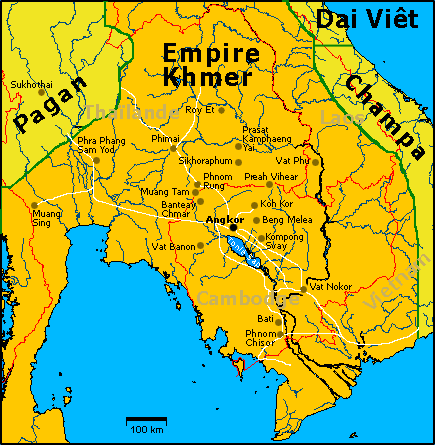
The Khmer Empire was one of the dominant powers of the Indochinese peninsula from the ninth to the thirteenth centuries.

The Empire, which succeeded the kingdom of Chenla, controlled periodically the regions that are now part of the states of Cambodia, Laos, Thailand, Vietnam and even Burma and Malaysia.

Its main heritage is located in Angkor, the site where the capital was at the peak of the country. This place bears witness to the power and wealth of the Empire, as well as the diversity of beliefs it has been subjected to over time. The official religions were successively Hinduism, Buddhism mahāyāna and finally Theravāda Buddhism.

The history of Angkor as the center of the historical kingdom of Kambujadesa from the 9th to the 13th centuries is indissociable from that of the Khmers.

Son of former King Dharanindra Varman II, the future Jayavarman VII who reigned from 1181 to 1219 was a prince at the head of a stronghold near Kampong Svay (in present-day Kampong Thom province); Yaçovarman II sent him to Champā as a military officer and was there when the Khmer sovereign was deposed by Tribhuvanâditya-Varman and did not return until much later in his principality.

In 1177, after the capture of Angkor by the Chams, he succeeded in reuniting an army and reconquering the capital.

He acceded to the throne and continued the war against his eastern neighbors until 1203 and the defeat of the kingdom of Champa, which had to yield a large part of its territory.

But if Jayavarman VII is known as the last great king of Angkor, it is especially for the great works realized during his reign, especially the new capital, baptized Angkor Thom that he created

Jayavarman VII at the Siem reap wax museum