Affichage des articles dont le libellé est China. Afficher tous les articles

mardi 28 février 2017

[List III/20a] Sui Chinese 隋朝 (581-623 AD)

I already have a Chinese army(my western Hàn army) but the rich history of this country and the differences between the armies of the various dynasties have always prompted me to develop other Chinese armies. The Song, the Wei or the Tang are all of particular interest to me (and I have long played these armies in 15mm on the rule DBM)

For several months, the Souei have attracted my attention.


The list is tactically pleasant and the troops varied. In Big Battle, it would give that:
- 3 Generals 4Kn
- 3 Sino-wei 4Kn
- 3 Chinese cavalrymen 3Kn
- 8 Pu-sing 3Pk
- 4 Pu-sing 8Bw
- 12 Pu-she Ps
- 1 Mo-ho (Mandchous) LH
- 2 Catapults Art

The composition of this list is quite free and the above proposal corresponds to my personal choice. None of my armies to this day has a similar combination. Moreover, it is very different from my Chinese army han. 


Sui dynasty 隋朝

One of the shortest dynasties in Chinese history, (29 years), although of great historical importance, the Sui dynasty reigned from 589 to 618. It made it possible for the Tang Three hundred and sixty years of division, the starting point of a "New Empire." It was from the first kingdom that unification came, which would be the work of Yang-kien, the descendant of a powerful family of the " Chinese aristocracy. The latter, after having overthrown the two Nordic states, conducted an army of five hundred thousand men to the south, seized the capital of the Chen, and proclaimed the Sui dynasty. (...) The Sui dynasty is characterized by its administrative and economic work, which served as a basis for the centralized Chinese Empire of the 7th and 8th centuries: construction of a large canal to supply China with Henan and Shanxi In the Wei Valley) in rice and other products from lower Yangzi (an area of ​​economic importance, and gigantic granaries in the Wei Valley and north-west of Henan. (Monique Vincent)


The Sui dynasty emerged when the daughter of the powerful Yang Jian became Empress Dowager of the Northern Zhou, with her son-in-law occupying the throne. After crushing a military insurrection in the eastern provinces, Zhou's prime minister, Yang Jian, deposed the emperor-child and enthralled Emperor Wendi of the Sui. During the associated purge, Wendi executed no fewer than 59 princes of the royal house of the Zhou while he succeeded, by his Confucian virtues, to be posthumously named "the cultivated Emperor"(文帝 wéndi) (Wikipedia)


Figures

Several manufacturers offer Souei, Newline design or TAG figures, for example. Other manufacturers offer Tang, several of which can be used in Souei.

Cataphracts TAG

Archers TAG

Spearman Newline design

mardi 13 septembre 2016

[List III/11b] Tü-Chüeh / Göktürk (Turks of Central Asia) VIIIth century AD


The  Tü-Chüeh ordo
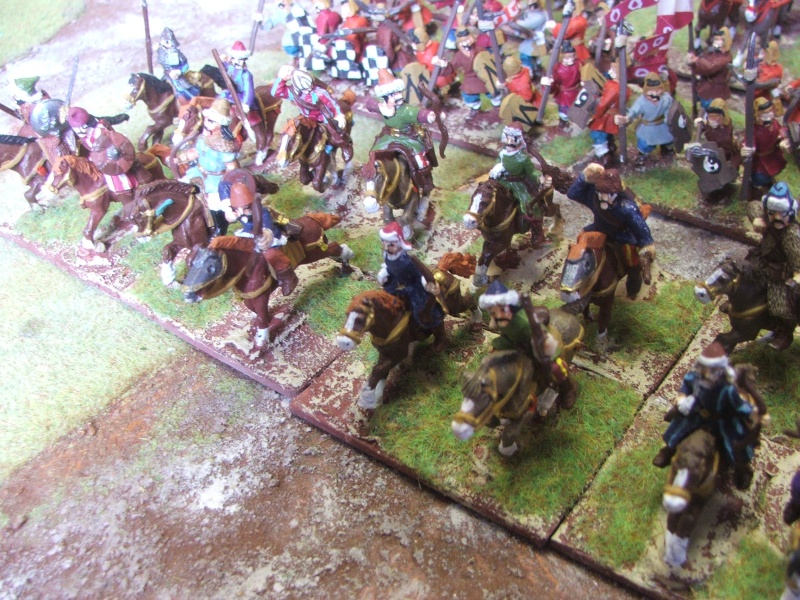
 1 general Cv, 2 caparisoned cavalry Cv, 8 light horses LH (one is missing on the photo above) and an unit mounted on bactrian camels Mtd-3Bw.
  
The Göktürk (552-745, in Chinese: 突厥 Tu-kiu) constituted a khanate created by the Ashina clan. They reigned over Central Asia and its creation contributed to the expansion of the Turks into the Caspian Sea. Two and a half centuries after their fall, the Turkish tribes reached Anatolia.


Standard awarded to Tu Chueh / Göktürk

At the beginning of the eighth century, the Turks created a script known as "runic" because it resembles the runes. They are the first nomads of Central Asia to have left inscriptions. Those written by the Göktürk originate from the Orkhon Valley in northern Mongolia. The heart of their empire was there. Entries from southern Siberia are attributable to other Turkish peoples. Those of the Yenisei valley, short funeral inscriptions, had to be written by the Kyrgyz.
    The Göktürk received Buddhist, Manichaean and Nestorian missionaries, but remained mainly Shamanists. They also had an imperial religion, tengrism, based on the veneration of Tängri, the God-Heaven. The language of the Göktürk is called the Göktürk. Référence: Wikipedia

  It is a nomadic army from Central Asia, generic enough in the outfit. I play it as Türuks (first Turkish) The DBA format allows me to play them alone against most opponents or align them as allies of my army in the city-state of Dunhuang.
 

The heavy cavalry including the khan


The Turkish nomad armies are largely made up of light riders, like their Iranian counterparts (Parthians, Scythians ...) or Mongols (Tartars, Khitan ...)


This army is one of the few to be able to align real camel drivers. Meharists of other armies, often called "camel-drivers", actually ride two-bumpredcamels. In the case of nomadic Turks, this is infantry mounted (fighting on foot with a bow and riding Bactrian camels for displacement).


The baggage of the army consists of a caravan of camels bactriens.


Territoires contrôlés par les T+u Chüeh au VIIème siècle

On the Ordoo forum of the Red Raven, dedicated to the horsemen, Che Khan wrote a presentation of this people. I quote it below:


    [The Tujue are considered to be the first ancestors of the great Türk family.
    There are several denominations for this people:
    Türks Tujue, T'ou-kiue, Türük or Köktürks ("Türks Bleus" in reference to the blue sky )
    At the beginning of the 6th century, they were pure nomads living in the Altai.
    They are known to have helped the Jouen-Jouen to crush a revolt of rebellious tribes.
But because of the ingratitude of these, they revolt. In 552, under the authority of the kaghan Bumin, they crush the Jouen-Jouen, whose empire immediately collapses.
This victory made it possible to establish until 630 the first dominion of the Tujue. This is the danger they represent for China, which leads to the second period of construction of the Great Wall.
 
The empire of the Türks Tujue is then composed of 2 parts:
The eastern Tujue Türks, located on a territory ranging from Manchuria to the Great Wall, whose center is the Orkhon Valley, and the seat is the Ötüken Forest, the sacred place of the Türks
The Western Tujue Türks of the Altai, which goes from Chinese Turkestan to the Sea of ​​Aral and Persia including the Sogdiana.
 
These were placed under the sphere of Sogdian cultural influence, of which they initially used writing and language. Sogdians administered their empire. Many religions such as Buddhism, Nestorian Christianity and Taoism coexisted during this period, but it was not possible to say whether one of them prevailed and was particularly adopted by the Türks. 
This first khanate reached its peak in the 6th century when the Western Tujue Türks first allied themselves with Iran and defeated the Hephtalites or "White Huns", then with Byzantium against Iran from 602 AD but without success . 
In the east, the eastern Tujue Türks worried China, which continued its policy of division, thus clearing the Western and Eastern Türks. The latter nevertheless benefited from troubles related to the end of the Souei dynasty. They attacked China several times around 620.They were however defeated in 630 by the Chinese empire with the advent of the Tang dynasty, and underwent their rule until 680. 
Around 680, the Kaghan Elterich reconstructed a second Tujue khanate, rallying the various Türk tribes. For 30 years, Elterich and his successors will carry out many victorious expeditions against China. 
But the domination to the west of the Altai is not frank, and even encounters failures against the Arabs who are already crowding in Sogdiana. Then, from 711, many struggles between tribes weakened the power of the Tujue until 740.
This second khanate, less brilliant than the previous one, saw the appearance of the first monuments with inscriptions in the Turkish language, using a "runic" alphabet.
]

vendredi 9 septembre 2016

[List III/08] [Tarim Basin] City of Touen-Houang (Dunhuang, 市 市)

About 15 years ago (I think) had passed on Arte a Chinese film whose title translated was The Silk Road. This film impressed me and was at the origin of several of my armies 15mm or 25mm.

(Moreover, it can not be found in France, if someone has a copy of it, I am a taker)


Originally the Silk Road checkpoint, the town of Dunhuang is located to the east of the Taklamakan Desert, near the junction of the two caravan trails that bypassed the desert, one from the north, The other from the south, from Central Asia.

It is one of the main places of diffusion of Buddhism towards China.

During the second half of the seventh century, the Tibetans seized Dunhuang, and were driven out only by the Chinese Tang Dynasty in the year 851 by a Chinese general, Zhang Yichao, before the city fell The dependence of other populations.

27 km south-east of the city are the caves of Mogao, where magnificent mural paintings, numerous statues including a 35-meter high Buddha statue and valuable medieval manuscripts have been discovered. The rediscovery of the frescoes around 1946 is mentioned and described by François Cheng in his book Le Dit de Tianyi.

Dunhuang was built by the Chinese in prefecture in 11 BCE by the Hans near the Shazhou oasis (沙洲) on a decision of Emperor Han Wudi, and after the campaign against the Huns by General Huo Qubing. The city was an important point of trade between China and the outside world during the Han and Tang dynasties, to the point that in the 2nd century it had a considerable population of 76,000 inhabitants. The first Buddhist caves were dug in 353, decorated with paintings by the pious travelers to guarantee the good completion of the perilous journey they had undertaken.

During the second half of the seventh century, the Tibetans seized Dunhuang, and were only expelled by the Chinese general, Zhang Yichao, by the end of the Tang Dynasty in 851 before the city fell Dependent on other populations.

That is why I chose, for my army, figurines of Tibetan heavy horsemen, not caparisoned, and Chinese-style infantry.

As early as the 16th century, the region escaped the Chinese empire, falling under the khaki of Djakhata
.


Heavy cavalry I
 

Heavy cavalry II

Turkish mercenaries

Levies
Milices I
Milices II
Baggages
The whole army with the allied body Tü Chüeh


jeudi 8 septembre 2016

mercredi 7 septembre 2016

[List II/41a] Western Han Chinese 漢朝 From 206 BCE to Year 9

Since I spent my Dunhuang army in big battle dba, I was trying to mount an army of their opponent histos. The Tangs and the Songs stick very well, as well as the Hsia hsians. For practical reasons (interesting sale of Hans by Nico on the New-wab forum), I opted for the Hans. (Their links with Dunhuang are attested by the frescoes of the Mogao Gipsies).


Overview of the Army (mainly Old Glory reinforced some Casting Rooms).


The heavy infantry. 6 plates of 8 figuines each. (1 row of 4 crossbowmen protected by the first line of halberdiers) The flags benefit from the wind in the back because Sun Tzu would have pulled my ears if I pulled my tiles against the wind.


The peasant levies, so enthusiastic that they must tie an iron collar to their necks. (I totally ignore the historical relevance that this fact but Old Glory and Castingroom both offer this type of "jewel" for the levies)


The luggage. This type of wheelbarrow was invented under the Han (although Curteys offer it for earlier periods)


The cavalry. Some Han armed forces in the Tarim or the Hsiung-nu steppes could be made up entirely of cavalry or mounted infantry.


The ballista (this model corresponds more to the more recent periods, -Song-) but as it is prettier than the Han balisters, it does not matter. Especially since the officer is a Han.


Turkish auxiliaries, very useful during the campaigns in the Tarim basin.