Affichage des articles dont le libellé est Successors. Afficher tous les articles

lundi 17 juillet 2017

[List II/22d] Kingdom of Characene

Army list. My army consists of two Arabo-Aramaic bodies of the Osmani tribe, who ruled the kingdom (list II/22d) and a body of nomadic pre-Islmaic Arabs (List II/23a). I chose to represent the Roman and Parthian period of the kingdom. The generals and heavy infantrymen are of the pure Arabo-Aramaic style as they were found in Hatra or Palmyra. The archers on foot are represented, as well as the light infantry, by veteran troops such as the pre-Islamic Arabs. The camel riders ride on naked dromedaries, less harnessed than the cataphractary dromedaries that could be found in Hatra or in certain armies of the Parthian suzerain.

- 2 Generals 4Kn
- 2 Light cavalry LH
- 2 Light camelmen LCm 
- 2 Heavy infantry 4Bd
- 3 Heavy javelinmen 3Ax
- 13 Archers Ps
Nomadic allies
- 1 General Cv
- 1 Light cavalry LH
- 1 Light camelmen LCm 
- 4 Camelmen Cm
- 3 Heavy infantry 4Bd
- 2 Archers Ps                         

 The Characene (or Kharacene or Caracene or Charakene or Mesen or Meshun in Judeo-Aramaic: חבל ימא, Hevel Yama "the land of the sea") is a former independent (or semi-independent) Hellenistic kingdom, located in the extreme South of the fertile region which lies at the mouth of the Tigris and the Euphrates, on the Arabian-Persian Gulf. In fact we do not really know its borders. They are different according to classical authors or geographers, but are traditionally associated with the southern region of Babylonia, in present-day Iraq, Iran and Kuwait.

    Basically, the kingdom must have as its boundaries to the west, the Arabian desert, to the north, the Chaldean marshes and to the south the Persian Gulf. Several islands in the Persian Gulf, including Bahrain, also belonged to the kingdom of Characena. It was created at the end of the 2nd century BC and was a vassal of the Parthian empire. It is very probable that the official language of the kingdom was the Greek koinè, the language spoken in the Hellenistic or Hellenized countries, but there is no certainty even today on this subject.

Source: Antikforever.com


 The kingdom of Characene is founded about 127 BC. BC by Aspasinè, named Hyspaosines by classical authors, an ancient satrap of Antiochos IV Epiphanes. Surviving the dissolution of the Seleucid Empire, the Characene became a vassal of the Parthian Empire until its fall at the beginning of the third century. The Sassanid kings put an end to the local royal dynasty and replaced it with governors.

Although vassal of the Parthians, the kingdom has always had a pro-Roman policy, and welcomed the Roman invasion of Trajan in 116. The emperor himself stays at Spasinou Charax, and personally attends the departure of the ships for India, regretting being too old to undertake the journey, as Alexander of Macedonia had done. Thereafter, the kingdom seems to have escaped long enough for the Parthians to take over Mesopotamia, it is only in 150 that it returns to the zone of direct influence of the empire of the Arsacides after the defeat of the King Meredate (or Meherdate) before Vologese IV. The latter undoubtedly takes an important spoil from Spasinou Charax, including a statuette of Hercules found in Seleucia of the Tiger and bearing the inscription that revealed this episode.

Source: Wikipedia


Coins of king Meredathes


Meredates seems to have been placed on the throne of Characene may be as governor initially, by a successor of his father Pacorus II after the Romans were driven out of the area of ​​Parthians. However, their invasion was at the origin of a civil war in the Parthian empire and Vologese IV was the son of a major rival of Pacorus II for the throne of "Great King." Vologesius IV attempted to re-establish his authority over several provinces of the Parthian empire which had declared independence during the war against Rome.

Meredates is also known by some coins, and by an inscription discovered in Palmyra. He was a son of Pacorus II as indicated by his coins stamped in the most Parthian style arsacide. The mention on the pieces confirms his filiation "Meredates, son of Phokoros, King of Kings, King of Omani"

jeudi 15 juin 2017

Egyptian sphinx

It is a small sphinx that can be used with my Egyptians, the Ptolemaïcs of Antoine or any other army of this region. 

It is intended to be played as a building, or even to be just used in decor without affect on the game, posed just for the visual and moved if it hinders the figurines. I did not want a sphinx too big but it nevertheless has a size giving it a look on the table.


jeudi 27 octobre 2016

[Classical Antiquity] Assault of the Syracuse Greeks against Seleucid Syria (BBDBA)

The impressive Seleucid army

The battle opposes the Greek army from Syracuse to the Seleucid army. The Greek is the attacker.

The game was played with the Big Battle DBA (BBDBA) rule with 36 bases per army.

The terrain chosen by the Seleucid player includes an arm of the sea, a river, two roads, some woods and a field, far from where the action will take place. A good part of the battlefield remains unobstructed in order to allow the loading of the chariots, elephants and knights, terrible weapons against which the Greek are well disarmed.

The row of poplars, along the road, is only decorative and will be removed if it is to generate the unfolding of the battle.

Greek army

 The Greek general has opted for a particular deployment. Fearing the strike force of the Seleucids, he abandoned the center of the battlefield. Supporting his defensive strategy on a wood and river, to the right of the battlefield. On the other hand, a more aggressive corps is destined to go along the coast and throw itself on the Seleucid right in order to preserve the initiative on one of the battlefield points.


 Celtic mercenaries having abused the pint on the preceding vigil, the Greek general thinks it more prudent to leave them in the boats and to disembark them when they have desolated. What Seleukos does not know.

Seleucid right wing

The Seleucid cavalry is assembled on the right wing of the army in three successive waves. The light riders (LH) at the head, followed by the riders (Cv), themselves pressed by the cavalry of shock (Kn). As the BBDBA rules allow, the subordinate generals have dismounted to fight feet, at the head of the phalanges. The platelets of Kn pass under the direct command of Seleukos, the general in chief


Left extremity of the Greek right wing.

The Greek right wing rests on the river

Worried by the presence of the numerous elephants (6 pads, the sixth of the enemy's army!) And the chariots, the Greek general left two pieces of riveting close to one another so that their shots could, If necessary, to support each other.


Seleukos, launched his army on the whole line of battle. The effort is accentuated on his right wing, where his cavalry manages it very quickly reaches near the Greek ranks.

The surprise landing of the Gauls.

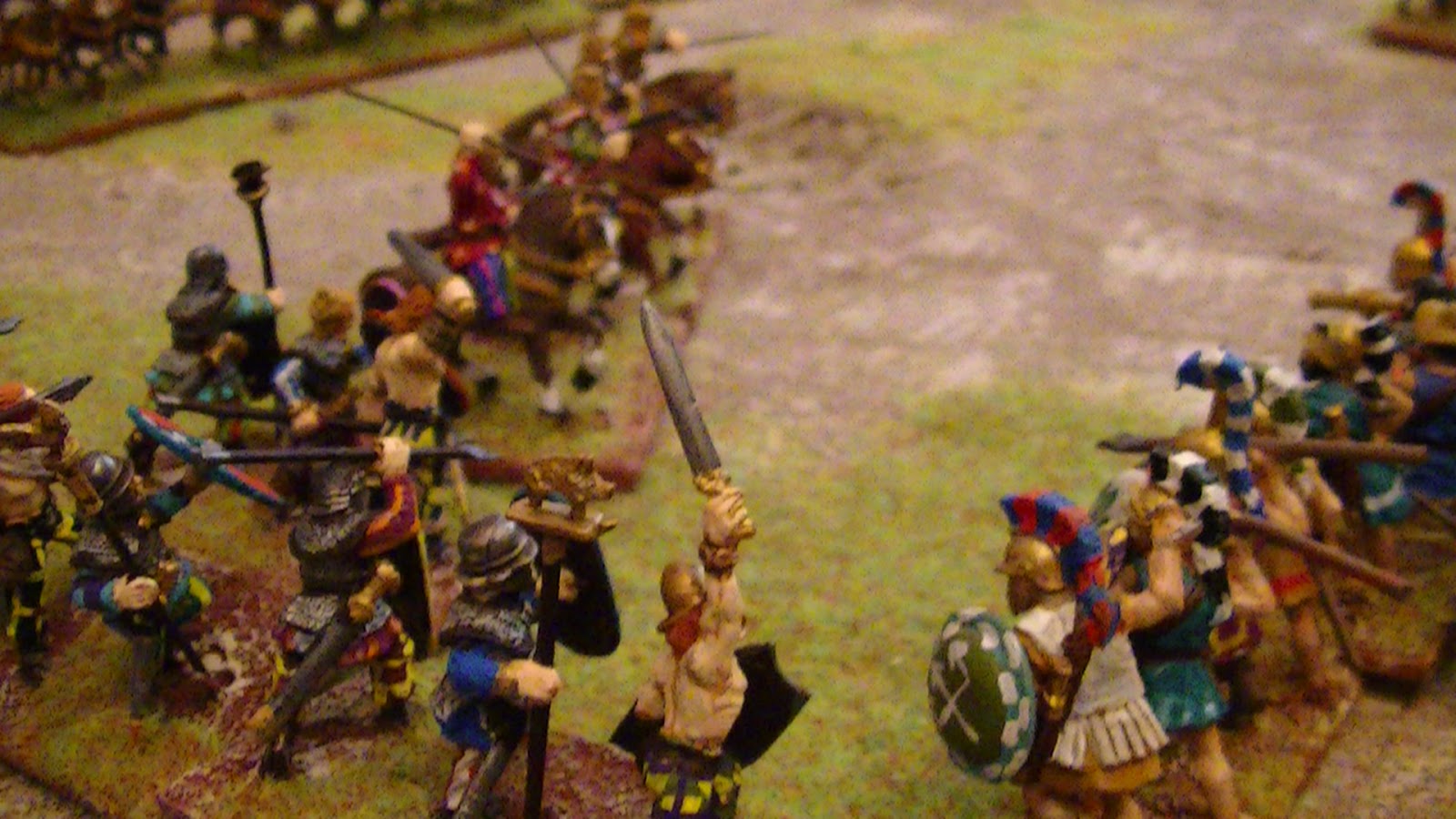
 The poker stroke of the Greek general then occurs. Celtic mercenaries emerged from the boats, much to the surprise of the Seleucids. (The Greek being the attacker, the platelets appear at the beginning of his first tale ... after the first Seleucid movement)

They quickly engage the enemy light riders on the beach. The struggle is desperate on both sides, the Celts risking a drowning assured if they are repulsed and the recoil of light riders caught flank being generated by their companions.


The Greek horsemen rush into no man 's land in the center of the battlefield, in order to be able to slow down the bulk of the Seleucid forces.


The Celtic mercenaries manage to set foot on the mainland. The situation becomes critical for Seleucid light riders.


View of the landing from the Greek ship (the photo allows me to notice that I have a lance to paint ^^)


 The Seleucid heavy cavalry sprang to the rescue of its isolated companions, lifting a thick cloud of smoke over the plain.


Too isolated, the light cavalry is annihilated before the arrival of this late support. It is attacked from the front by the hoplites and taken by flank by the Celtic mercenaries and a unit of light Greek riders who have detached themselves from their companions guarding the center of the battlefield.


In the shelter of the river, the Greek army is advancing. The hoplites rush to keep the bridge, the artillery is reoriented to support the troops who have remained on the other side, while the cavalry and the psilois go straight ahead in search of a fordable passage well beyond The Seleucid line.


The Seleucid heavy cavalry, arrived too late to support its light troops, is, in turn, stuck in the Greek line.


Séleukos and his heavy shock cavalry

Seleukos and the Cavalry of Shock observe from the third line, the assault of the heavy cavalry. A chariot and phalanges are sent in support in order to avoid asphyxiation of the riders, attacked from all sides.


The Seleucid heavy cavalry is annihilated.
Right extremity of the Greek left wing.
In the center of the battlefield, the Greek horsemen do not make the weight and fail to retain as much as they wanted the enemy line. They then retreated to lean on the right extremity of the left wing of their army. The Seleucid warriors hit hard on the hoplites present in this area of ​​the battlefield.


The bridge over the river is in under hoplites' control.


Seleucid left wing bypass
The Greek psiloi and heavy horsemen (led by the general-in-chief) forded the river behind the Seleucid line, near the encampment of the latter. "It stinks a lot" for the Seleukos army

Note: lacking Greek heavy riders, these bases are represented by Gallic mercenary horsemen, which comes to the same n term of play and is not historically shocking for an army of Syracuse.


 Having no cavalry on its left wing, the Seleucid can send as fast troops only slingers in order to desperately attempt to cut the road of the camp to the skirmishers and the Greek cavalry.


 The hoplites abandoned the bridge to throw themselves on the exposed side of the Seleucids, the artillery having shot down one of the most menacing elephants.


 Against any prognosis and probability, the Seleucid slingers blocked the enemy advance towards their encampment. Their heroism even saves enough time to allow a heavy chariot to come to support.


The wing of Seleucid cavalry, demoralized and largely destroyed, is on the run. The Greek general succeeded in reorganizing his troops patiently so as to remain in order for the priest who was preparing against the Seleucid center, which was very powerful but heavy and not very manoeuvrable.


 A critical moment for the Seleucid slingers blocking the road to the camp. They will survive this episode and will repel their opponents (again against any probability ^^)


The Ligurian and Iberian mercenaries of Syracuse hold the wood on which the Greek right wing rests and neutralizes an important enemy strike force.


 The heroic defense stood firm and the road to the Seleucid camp is now cut off for the Greek general.


 On the other hand, on the battlefield rises, the losses are too great for the Seleucids and the army, demoralized, runs away.

The victory came to the Syracusans.


 The only consolation for Seleukos: after saving the encampment, the slingers succeeded in rejecting the Greek general to the river, and it was by retreating, from the water to the waist, that he attended the victory of his army and To the Seleucid rout.


In terms of game, the victory is very important, the Greek player having lost only 3 pads out of the 36 engaged. Viewing the power of the Seleucid army this was very unexpected (and does not reflect the battle, where things were not so decided)

As part of our "championship" internal to the player group, the scores obtained are 71 to 3. Which is, at this time of the championship the largest score.

(72 kills, the Seleucid kills three> 3 pts, so the Greek has 72-3 = 69 points + 2 bonus points for killing one of the three enemy generals)

samedi 10 septembre 2016

[List II/19] Seleucids χήρχή Σελεύκεια late 4th century BC


This is not one of my armies, but one of my son Antony's. It corresponds to a pompous period of the Seleucid kingdom and there is a plethora of "noble" troops and gadgets (elephants, floats). The army however predates the use of cataphractory cavalry.

It is built on the BBDBA format.


Basileus Nikator (Seleucos) and the rest of the staff

Séleucos
 

The large number of elephants resulted from the agreement between Séleucos and Chandragupta. Indeed, from 308, he engaged against the Indian prince Chandragupta Maurya a long conflict, which is settled by a treaty of peace in 303: Seleucos must abandon the Indian satrapies of the empire (Gandhara), as well as the oriental parts Arachosia and Gedrosia, but he succeeded in preserving Bactria. This exchange of territories is accompanied by an alliance sealed by a marriage between a Seleucid (unidentified) princess and the emperor maurya. Seleucus also sends Megasthenes into the embassy at the court of Pataliputra on the Ganges, and receives a contingent of 500 elephants of war. It is traditionally at this period that the beginning of the formation of the Seleucid Empire is placed.


Scythed chariots

Heavy cavalry

Bactrians


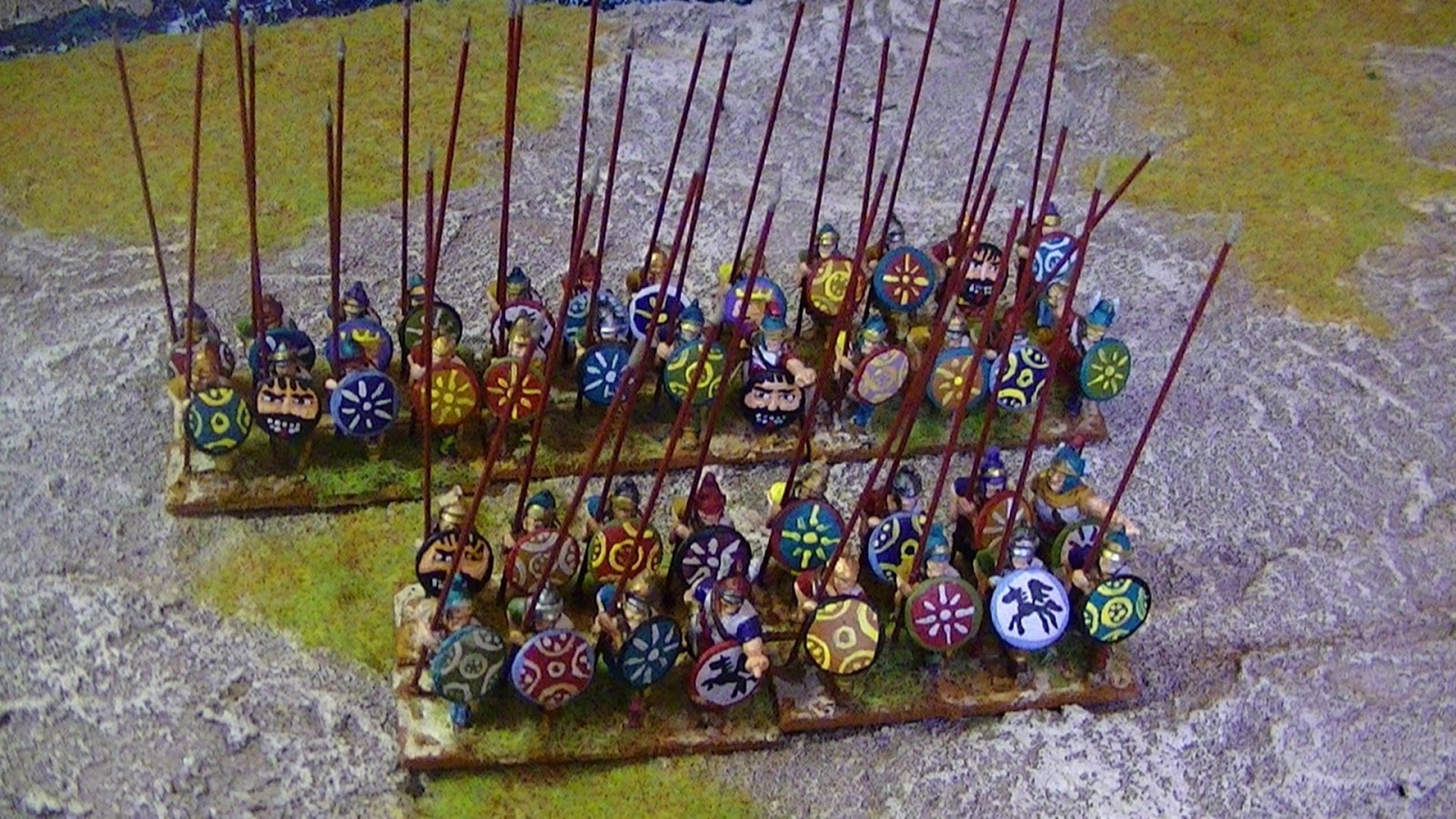
Chalkaspids
Argyraspids
Psiloi


Link about the Seleucid: here
Link about one of the seleucid's neightborss and enemies: here